
Community Science
You can play an important role in pollinator conservation just by documenting what you see...
- Submit your observations of bees to this project: Bees of San Diego County · iNaturalist
- Learn How to Make an Observation : iNaturalist Help
- Bee photography tips and tricks - CA Native Bee Society
- Help monarchs by documenting them:
- If you see a monarch, take a photo and submit it to iNaturalist: Have you seen me? Help monarchs in 3 easy steps.
- Join the Western Monarch Milkweed Mapper iNaturalist Project
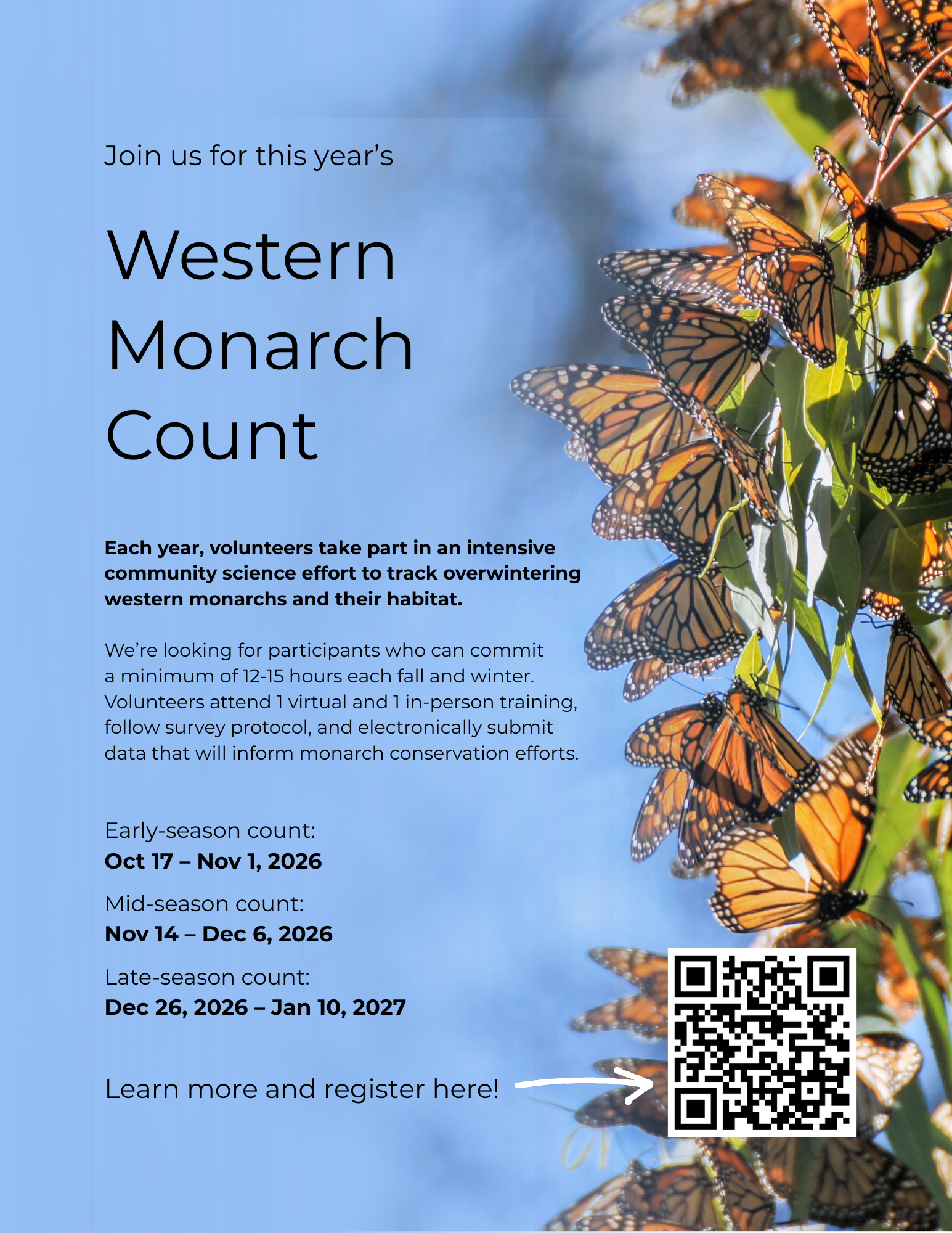
- Volunteer for the Western Monarch Count:
- Join a community-powered initiative to track overwintering western monarchs and their habitat along the California coast between October and January. The RCD of Greater San Diego County is the regional coordinator. Volunteer with us!
-
Required virtual training for first-time volunteers: Wednesday, October 7th | 5:30-7:30pm
A link to the training will be emailed to registered new volunteers. -
In-person trainings (required for first-time volunteers):
- Saturday, September 26th | 9am - 12pm
- Saturday October 10th | 9am - 12pm
- Please register here.
Bumble bees, like other pollinators, are facing population decline, and we need everyone's help documenting bumble bees wherever they're seen to know where they are and how many are seen. Five species of bumble bees are regularly found in San Diego County: the Yellow-faced Bumblebee (Bombus vosnesenskii), Sonoran Bumblebee (Bombus sonorus), Black-tailed Bumblebee (Bombus melanopygus), California Bumblebee (Bombus californicus), and Crotch's Bumblebee (Bombus crotchii).
Here's what you can do to help: take photos of bumble bees when you see them!
-
Add photos to the Bumble bees of San Diego County project on iNaturalist.org hosted by the Nat.
- If you're not sure what you see is a bumblebee, you can still submit to the iNaturalist project, and reviewers on iNaturalist will identify your observation.
-
Submit observations to Bumble Bee Watch:
- Bumble Bee Watch is a collaborative effort to track and conserve North America’s bumble bees. Everyone is invited to contribute to this important community science effort. Have fun while learning more about bumble bees and the vital role they play in our environment!

Honey bees that escape cultivation to become a self-sustaining population are called "feral." The ecological pressure exerted by honey bees on native pollinators and native plants in San Diego County is very high, but more information is needed to fully understand their impacts.
- Southern California has the highest density of feral honey bees anywhere in the Western Hemisphere (Hung et al. Proceedings of the Royal Society B, 2018).
- In just two visits to a flower, honey bees can take up to 80% of available pollen from a flower. (Travis et al. Insect Div. & Conserv. 2025)
- In San Diego, honey bees account for over 75% of floral visitors. (Travis et al. Insect Div. & Conserv. 2025)
- Native bees visit many more flowers, and thus offer a higher pollination service to plants, maintaining higher genetic diversity compared to honey bees. (Hung et al. Ecol. Appl. 2023) Native bees are critical to maintaining the fitness of native plants.
- Rare plants are pollinated primarily (and at times exclusively) by native bees. (Hung. et al. Proc Royal Soc B, 2019)
It is unclear how honey bee domination in Southern California is modifying plant and pollinator community composition and there is a need to study the effects of prolonged honey bee exposure on plant and pollinator evolution.

What you can do
You can help understand the impact of feral honey bees on San Diego ecosystems by submitting observations of feral swarms and hives when you see them! These iNaturalist projects are managed by local ecologists.
Submit pictures of honey bee swarms to this iNaturalist project: Honey bee swarms · iNaturalist
Submit pictures of feral hives to this iNaturalist project: Nesting bees · iNaturalist