
Protecting Southern California’s At-Risk Butterflies by Prioritizing Conservation Action
The Wildlife Conservation Board (WCB) has awarded $601,577 to the Resource Conservation District of Greater San Diego County to lead a planning project that will bring key partners together to develop a restoration approach to address threats while securing the necessary permits to move forward with habitat restoration and translocations.

Butterfly species are catastrophically declining across the west, including in California. The main drivers of their decline are habitat loss and degradation plus climate change. Areas with high levels of urbanization and hotter, drier climates like southern California have higher numbers of at-risk butterflies (Marschalek and Deutschman 2024). Southern California is home to four of the most at-risk butterfly species in the state: Hermes copper (HCB), Quino checkerspot (QCS), Harbison’s dun skipper (HDS), and Laguna Mountain skipper (LMS). These four butterfly species only occur in Southern California and are at risk of extinction due to persistent threats. In addition to the loss and fragmentation of habitat, these butterflies have been threatened degradation to their habitat by the invasion of nonnative-invasive plants and the effects of extreme events driven by climate change such as flood, drought, and wildfire, which in some cases have led to extirpation (the local disappearance of a species).
Conservation plans, including regional plans and federal recovery plans for the listed species recognize the need for habitat creation as well as translocation of species to locations where they have been lost to increase resiliency across their range.

This planning project includes focused surveys and habitat assessments to identify extant populations and sites for potential restoration or translocation, development of a final restoration approach for Harbison’s dun skipper and the Quino checkerspot butterfly (a new California Endangered Species Act candidate species), and completion of environmental review and permitting for proposed restoration activities. The project will also streamline translocation approvals for the four focal butterfly species. By accomplishing these actions, this project will advance objectives in the forthcoming San Diego County Butterflies Habitat Conservation Plan and federal recovery plans by bringing partners together to create an approach to multi-species conservation that can be achieved though future implementation grants.
This collaborative project draws on the expertise of a team of partners including the San Diego Zoo Wildlife Alliance, California Department of Fish & Wildlife, Bureau of Land Management, US Fish and Wildlife Service, US Forest Service, US Geological Survey, San Diego Management and Monitoring Program, the San Diego Association of Governments, Xerces Society for Invertebrate Conservation, San Diego Natural History Museum, San Diego County Parks.
The Hermes copper butterfly (Tharsalea hermes)

Hermes copper is a rare butterfly endemic to San Diego County and Baja California Norte, Mexico. The species is listed as Threatened by the USFWS. Surveys over the past two decades funded by the San Diego Association of Governments (SANDAG), have documented continued decline despite finding new populations[1]. In fact, a recent evaluation of population trends of butterflies across the continental United States found that HCB is the second fastest disappearing species [2].
Key threats to HCB include wildfire and drought. HCB are usually unable to recolonize habitat following disturbances due to habitat fragmentation and small, isolated populations. As a result, wildfires typically lead to local extirpation. Recolonization has only been documented in two sites following burns. More recently, severe multi-year droughts have further reduced the distribution of the species[3]. Mortality resulting from wildfires and drought, lack of recolonizations following fire or drought, and evidence of restricted dispersal[4] places the HCB at increased risk of extinction. Assisted dispersal via translocation of individuals has the potential to mitigate threats to the population.
Translocation offers hope of recovering this species. Past efforts to translocate HCB from larger populations showed promising results4, however, continued translocation efforts were not possible because extant populations were too small to support capturing and moving individuals3. The San Diego Zoo and Wildlife Alliance, a partner on this project, is already working on head-starting HCB captive rearing. The long-term viability of HCB as a species is dependent upon reintroduction within their historic range. Without such efforts, the species faces a real and imminent risk of extinction.
Quino checkerspot butterfly (Euphydryas editha quino)

In the 1970s, the Quino checkerspot butterfly was one of the most abundant butterfly species in southern California[5]. Today they are among the rarest5,[6]. They have been extirpated entirely in Los Angeles, San Bernardino and Orange counties. Today, QCB is restricted to San Diego and Riverside Counties in the USA and northern Baja California5,6. QCB was listed by the U.S. Fish and Wildlife Service (USFWS) as an endangered species in 1997, and became a candidate under the California Endangered Species Act in August 2025. QCB is also considered high priority for species-specific management in the Management and Monitoring Strategic Plan for Conserved Lands in Western San Diego County (MSP Roadmap) and categorized as “SL Species”, or those at risk of being lost from the MSP area.
Key threats to QCB are development, habitat fragmentation, nonnative plant invasion, and increased fire frequency, all of which have led to a sharp decline in their distribution5,6,[7]. Climactic changes such as drought have also played a major role in declines along with habitat loss and fragmentation due to development. Dry years lead to a lack of availability of the species’ host plant which can limit opportunities for oviposition or can increase competition between caterpillars. Wildfire is also a threat, including during the winter period when the species is dormant in their larval stage. In 2025 the Border 2 fire burned 90% of the main donor site for SDZWA’s QCB captive rearing program. Subsequent monitoring has found that heat from the fire killed much of the host plant seed bank and cryptogrammic crust (and likely QCB larvae) within the 10% of the site not directly consumed by fire.
Connectivity between habitat patches is critical as is the quality and quantity of resources within a given patch. Long-term consistent monitoring data do not exist for QCB as there are no county-wide efforts through San Diego’s Multi-Species Plan. With the exception of the San Diego National Wildlife Refuge where habitat was assessed for the SDZWA’s translocation program, habitat has not been thoroughly assessed to help determine where restoration could be targeted to enhance both occupied and unoccupied sites in the various metapopulations. Our project will assess habitat to support restoration as well as help identify sites to serve as donor or recipient populations during translocation efforts.
Harbison’s dun skipper (Euphyes vestris harbisoni)
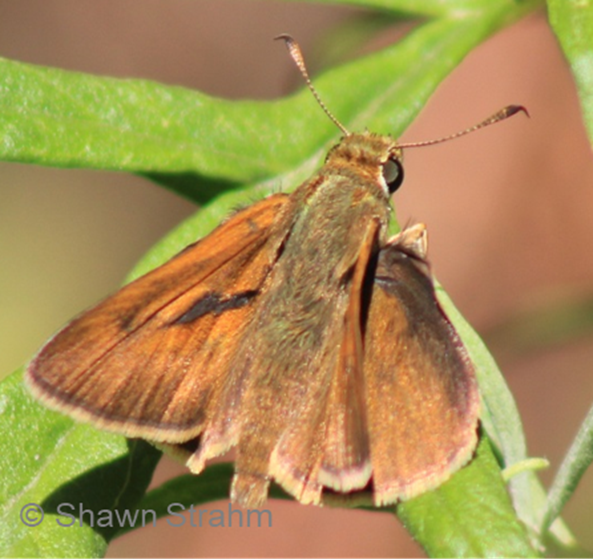
The Harbison’s dun skipper is restricted to southern Orange County, extreme western Riverside County, and San Diego County, with one record from Mexico[8],[9]. The larvae of this skipper feed only on San Diego sedge (Carex spissa) and are generally associated with oak woodlands. Since 1991, entomologists have expressed concern that the skipper is rare and may be negatively impacted by habitat loss and degradation[10]. In 1989, the United States Fish and Wildlife Service issued a notice of review, on which Harbison’s dun skipper was listed as a Category 2 species[11]. In 1991, HDS was petitioned for federal listing, but it was determined the petition did not include sufficient information for review. The current numbers of HDS are perilously low and put them at high risk of extinction. It is imperative to make every effort to conserve a species before its numbers are too low for efforts to be meaningful.
Surveys for larvae and adults in 2013-17 indicate that the range of the species has become increasingly fragmentated due to development but also local extirpations resulting from wildfire and flood conditions9. Wildfire can reduce the overstory which shades the riparian areas where HDS’ sedge host plant occurs; it has also caused extirpations from sites where fire was particularly severe. Drought can affect populations of their sedge host plant by causing die-back. Conversely, floods- which are becoming more common as climate change increases extreme weather events- can scour out the sedge, including the larvae which overwinter in their leaves. Additional threats to HDS include grazing, and habitat degradation associated with the spread of the gold spotted oak borer (Agrilus auroguttatus), which can kill the oaks in the riparian areas preferred by this species.
Enhancing habitat to support existing populations is critical to maintaining the species. It is also important to translocate individuals so they are better distributed on the landscape to avoid continued extirpations due to stochastic events like drought and fire and hopefully establishes new populations. This project will assess habitat and develop restoration plans to support HDS.
The Laguna Mountain skipper (Pyrgus ruralis lagunae)

The Laguna Mountain skipper is another rare species endemic to Southern California. Historically they occurred in two locations: the Laguna Mountains and Palomar Mountain. The skipper has not been detected in the Laguna Mountains since the 1990s and is thought to be extirpated there[12]. LMS is listed as endangered by the U.S. Fish and Wildlife Service.
LMS larvae feed on leaves of a wetland-associated plant in the rose family. Drought has significantly affected high elevation wetland meadows where LMS’ host plant occurs, leading to a lack of sites for females to oviposit as well as a dearth of nectar resources.
Between 2007-08 there was intensive surveying and habitat quantification efforts[12],[13]. There are also ongoing head-starting efforts by SDZWA and partners to reintroduce LMS to the Laguna Mountains[14], though they have had limited success and are exploring additional potential sites, which permitting would cover.
[1] Chambers Group, Inc. 2011
[2] Edwards et al. 2025
[3] Marschalek and Deutschman 2018a, 2018b, 2019
[4] Marschalek et al. 2016
[5] Mattoni et al., 1995
[6] Anderson et al., 2003; CFWO, 1997, 2019
[7] Preston et al., 2008, 2012
[8] Brown and McGuire 1983
[9] Marschalek et al. 2019
[10] Brown 1991; Glassberg 2001
[11] Marschalek and Deutschman 2016
[12] Grant et al. 2009
[13] Marschalek et al. 2017
[14] Johnson et al. 2010
Project Contact
MC Moazed, Habitat Programs Manager
mc.moazed@rcdsandiego.org
(619)562-0096